
Table of Contents
Exterior construction refers to the engineering and manufacturing processes that form a vehicle’s outer shell, encompassing body panels, structural supports, and protective coatings. This foundational system directly impacts safety ratings, aerodynamic efficiency, and long-term durability across all vehicle segments.
The vehicle body represents approximately 25-30% of total manufacturing costs. Understanding how manufacturers approach exterior build quality separates premium vehicles from budget alternatives.
Core Materials Driving Exterior Construction Standards
Steel remains the backbone of mass-market vehicle production. High-strength steel (HSS) and advanced high-strength steel (AHSS) grades now comprise 60-70% of modern body structures, according to the American Iron and Steel Institute. These materials deliver exceptional crash energy absorption while maintaining cost efficiency.
Aluminum adoption has accelerated across luxury and performance segments. The material offers 40% weight reduction compared to steel equivalents, directly improving fuel economy and handling dynamics. Ford’s F-150 transition to aluminum body panels marked a watershed moment for mainstream aluminum integration.
Carbon fiber reinforced polymer (CFRP) remains limited to ultra-premium applications due to manufacturing complexity and material costs exceeding $20 per pound. BMW’s i-series vehicles demonstrate CFRP’s potential when production volume justifies the investment.
| Material | Weight Density | Cost Per Pound | Corrosion Resistance | Primary Application |
|---|---|---|---|---|
| Mild Steel | 490 lb/ft³ | $0.80 | Moderate | Non-structural panels |
| AHSS | 490 lb/ft³ | $1.20 | High | A/B-pillars, rocker panels |
| Aluminum 6000 | 169 lb/ft³ | $2.50 | Excellent | Hoods, doors, trunk lids |
| Carbon Fiber | 112 lb/ft³ | $22.00 | Excellent | Performance applications |
Manufacturing Methodologies in Modern Exterior Construction
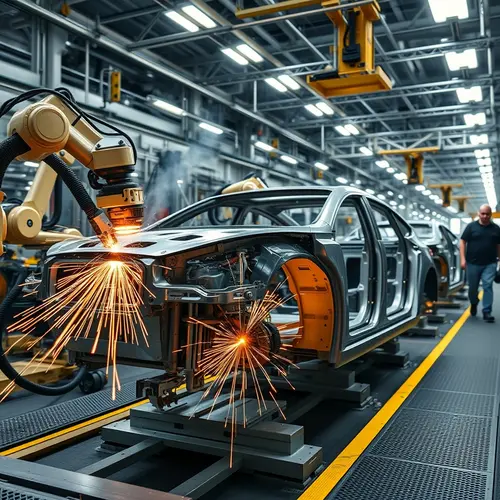
Unibody construction dominates passenger vehicle production. This approach integrates the chassis and body into a single structural unit, welded together through hundreds of connection points. The method provides superior torsional rigidity while reducing overall weight compared to body-on-frame designs.
Body-on-frame architecture persists in truck and SUV segments where maximum towing capacity and off-road durability take priority. The separate frame rail system absorbs extreme stress loads that would compromise unibody integrity.
Stamping and Forming Precision
Large-format stamping presses apply 1,000-2,500 tons of force to transform flat steel sheets into three-dimensional body panels. Manufacturers maintain die tolerances within 0.1mm to ensure consistent panel gaps and aerodynamic performance.
Hot stamping processes heat steel blanks to 1,650°F before forming, enabling complex geometries impossible with cold-forming methods. This technique produces the ultra-high-strength components protecting passenger compartments during collisions.
Joining Technologies Defining Exterior Construction Quality
Resistance spot welding connects 3,000-5,000 individual points across a typical vehicle body. Each weld creates a fusion zone approximately 5-7mm in diameter, generating mechanical bonds capable of withstanding 500-800 pounds of shear force.
Structural adhesives supplement traditional welding in premium applications. These epoxy-based compounds distribute stress loads across broader surface areas, reducing stress concentrators that initiate fatigue cracks. Adhesive bonding also enables multi-material joining where dissimilar metals would create galvanic corrosion through direct contact.
Protective Coating Systems in Vehicle Exterior Construction
Electrocoat (e-coat) primer application occurs through complete body immersion in charged paint particles. This process ensures 100% coverage across all external and internal surfaces, including hidden cavities where manual coating would fail. The resulting film thickness measures 20-25 microns.
Base coat and clear coat layers add color aesthetics and UV protection. Premium manufacturers apply 4-6 separate coating layers, achieving total film builds exceeding 100 microns. This investment directly correlates with paint durability and gloss retention over the vehicle lifecycle.
Aerodynamic Integration Within Exterior Construction Design
Drag coefficient targets have declined from 0.40 to 0.25-0.28 across mainstream sedans. Every 0.01 reduction in drag coefficient improves highway fuel economy by approximately 0.2-0.3%.
Active aerodynamic elements represent the cutting edge of exterior construction innovation. Deployable front air dams, adjustable rear spoilers, and active grille shutters optimize airflow based on speed and cooling demands. These systems deliver measurable efficiency gains without compromising styling flexibility.
Common Misconceptions About Vehicle Exterior Build Quality
The automotive press frequently perpetuates the myth that panel gap consistency directly indicates overall build quality. While tight tolerances demonstrate manufacturing precision, they reveal nothing about structural integrity, corrosion protection, or crash performance.
German manufacturers intentionally specify slightly wider panel gaps (3.5-4.5mm) compared to Japanese competitors (2.5-3.5mm) to accommodate thermal expansion in aluminum-intensive designs. This engineering decision prevents stress cracks and paint damage during extreme temperature cycling.
Real-World Exterior Construction Failure Analysis
A common warranty claim involves premature clear coat delamination on horizontal surfaces. Investigation typically reveals insufficient surface preparation before coating application. Residual stamping oils or inadequate phosphate conversion coating prevent proper adhesion between primer and base coat layers.
Manufacturers address this through enhanced cleaning protocols, including alkaline spray washing at 140-160°F followed by deionized water rinses. Quality control measures now include surface tension measurements ensuring wettability exceeds 38 dynes/cm before coating operations commence.
Safety Standards Governing Exterior Construction Requirements
Federal Motor Vehicle Safety Standard 214 mandates minimum door intrusion resistance during side-impact collisions. Manufacturers achieve compliance through strategic placement of ultra-high-strength steel beams within door structures, typically using materials exceeding 1,500 MPa tensile strength.
The Insurance Institute for Highway Safety (IIHS) small overlap crash test drives continuous improvement in front-end structure design. This evaluation exposed significant weaknesses in early unibody architectures, forcing industry-wide revisions to load path engineering.
Practical Considerations for Vehicle Owners
Understanding your vehicle’s exterior material composition informs proper maintenance practices. Aluminum panels require pH-neutral cleaning products to prevent oxidation staining. Steel components benefit from regular undercoating inspections to identify coating breaches before corrosion initiates.
Multi-material construction creates unique repair challenges. Certified collision repair facilities must use material-specific joining techniques and avoid cross-contamination between steel and aluminum work areas to prevent accelerated galvanic corrosion at repair sites.
- Inspect rocker panels and wheel wells for coating damage after winter salt exposure
- Address stone chips within 48 hours to prevent moisture intrusion beneath surrounding paint
- Avoid aftermarket roof racks that concentrate stress loads on unsupported panel areas
- Use manufacturer-approved touch-up paint containing identical pigments and binders
- Schedule professional paint thickness measurements every 3-5 years to detect early delamination
Vehicle exterior construction represents the synthesis of materials science, manufacturing precision, and safety engineering. The visible body panels conceal sophisticated structural systems engineered to protect occupants while delivering aesthetic appeal and aerodynamic efficiency. Recognizing quality indicators and understanding maintenance requirements extends vehicle lifespan and preserves resale value across all market segments.
Dinda Margareta is a senior automotive editor at Auto Store covering collision repair, EV tech, and classic restoration. 5+ years, 130+ guides. Method: OEM position statements and repair data cross-reference. Author of 2,333 auto guides since 2022.

More Stories
Essential Guide to seismic upgrades for Safer Buildings
Essential Auto Restoration Tools: 10 Must-Haves for Pros
Interior Auto Restoration Guide: Pro Tips That Last